

How 300 Years of Evolution Is Reshaping Growth, Perpetuation, and Market Strategy Today
The property and casualty (P&C) insurance industry is one of the oldest financial systems in the world — born out of catastrophe, built through necessity, and continually reshaped by commerce, technology, and human behavior. But for all its heritage, today’s distribution environment is arguably the most complex, interconnected, and strategically important it has ever been.
Table of Contents
To understand where the industry is going, it helps to understand how it began — and how three centuries of evolution brought us to this moment.
For property and casualty insurance programs and quotes, head over to ProgramBusiness.com to find a solution.
From Fire Marks to Global Distribution: The 300-Year Journey
The P&C industry traces its roots to the Great Fire of London in 1666, a disaster that led to the creation of organized fire insurance and structured risk pooling. A decade later, in 1676, Hamburger Feuerkasse became Europe’s first formal fire insurer.
The American market soon followed:
- 1732: The first U.S. fire insurer was founded in Charleston, South Carolina.
- 1752: Benjamin Franklin established the Philadelphia Contributionship, still in operation today.
- 1800s–1900s: Insurance expanded to cover autos, liability, workers’ compensation, and emerging commercial risk.
These milestones built the foundation for today’s sprawling distribution ecosystem — a marketplace that spans:
- Program carrier incubators
- Independent retail agencies
- Managing general agents (MGAs) and wholesalers
- Agency networks, aggregators. associations
- National and global brokerages
- Program administrators
- Platforms backed by private equity (PE)
- Insurtechs
What was once a localized community model is now a highly sophisticated distribution engine connecting carriers to more than 16 million U.S. businesses seeking insurance protection every single year.
Why Today Is a Defining Moment in P&C Distribution
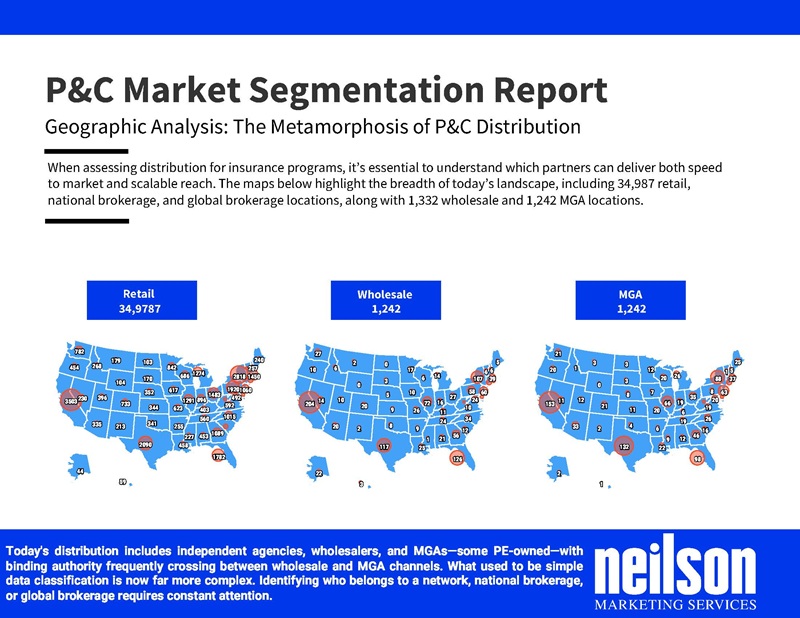
The infographic data tells the story clearly. Across the United States today, there are:
- 34,987 retail, national brokerage, and global brokerage locations
- 1,332 wholesale locations
- 1,242 MGA locations
PC 2025 Distribution
And within these numbers are powerful structural shifts:
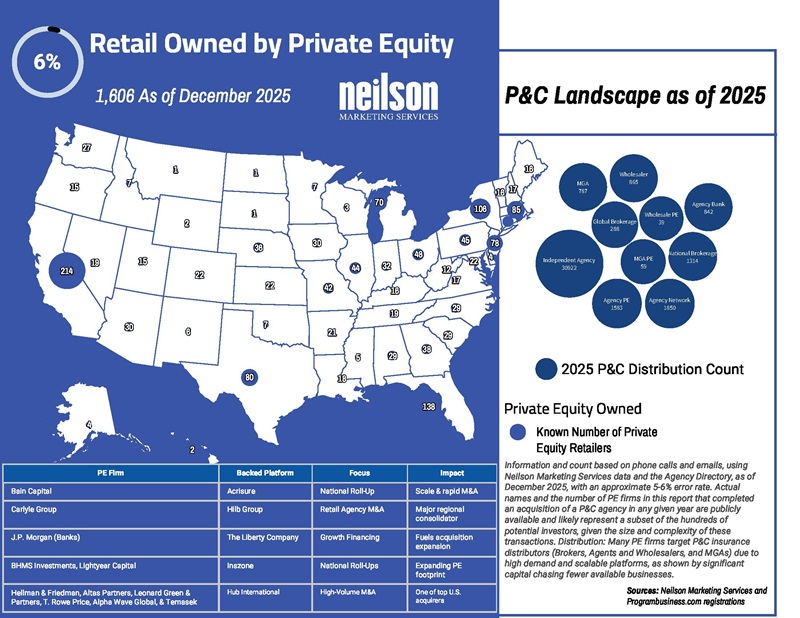
- 30,922 independent agencies
- 1,583 PE-owned retail agencies
- 1,850 agency networks
- 1,314 national brokerages
- 288 global brokerages
- 865 wholesalers
- 59 PE-backed MGAs
- 39 PE-backed wholesalers
Distribution is no longer a straight line from producer to carrier. It’s a matrix of relationships, authority levels, ownership structures, and competitive dynamics.
Understanding this ecosystem is now essential for:
- Carriers
- MGAs
- Wholesalers
- Retail agency principles
- Reinsurance partners
- Trade associations
- Insurtechs
- PE-backed consolidators
Each has a stake in how distribution evolves and how submissions flow across the market.
The Rise and Influence of Private Equity
Private equity has reshaped the distribution landscape at record speed. As of 2025: 1,606 retail agencies, or roughly 6% (or more), are PE-owned. Multiple MGA and wholesale platforms are also PE-backed.
PC 2025 Distribution
The PE influence matters for three reasons:
- Scale and purchasing power have shifted. PE-backed firms negotiate differently, invest aggressively in technology, and often consolidate market share rapidly.
- Regional books have realigned. Local agencies that once controlled community business now operate under national or super-regional platforms.
- Carrier relationships and appointment strategies are changing. Access, appetite alignment, and renewal control all look different when books migrate under new ownership.
The distribution map of the infographic below shows wide state-by-state variation. California alone has 214 PE-backed retailers, while other states show single-digit counts. This uneven concentration influences competition, pricing leverage, and program scalability.
The Modern Challenge: Understanding “Who’s Who” in Distribution
Three decades ago, categorizing distribution was simple: retail → wholesale → MGA → carrier. Today, that clarity no longer exists:
- Wholesalers operate as MGAs.
- Carriers operate as MGAs.
- MGAs operate with wholesale distribution arms.
- Networks blur the definition of “independent.”
- National brokerages own agencies that appear locally.
- Program administrators sit between wholesalers and carriers.
The line between producer, aggregator, and intermediary is constantly shifting. What used to be an easy data classification exercise is now a full-time job.
And this matters because misclassification leads to misalignment — and misalignment leads to lost submissions, poor agent onboarding, and programs that fail to scale.
Where the Business Actually Exists: Geographic Opportunity
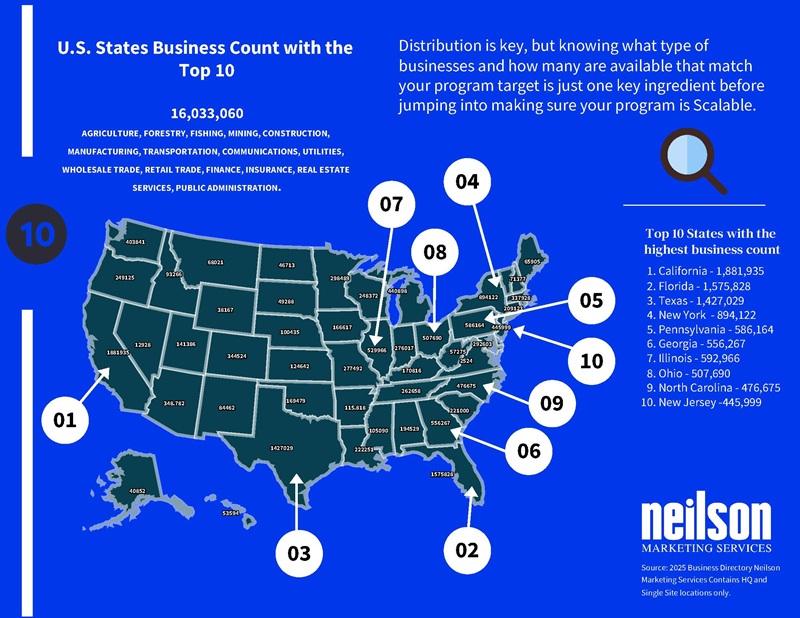
There are more than 16 million insurable U.S. businesses, and where those businesses reside directly impacts distribution strategy. All commercial programs fall into one of the following categories, so do your homework:
- Agriculture
- Forestry
- Fishing
- Mining
- Construction
- Manufacturing
- Transportation
- Communications
- Utilities
- Wholesale trade
- Retail trade
- Finance
- Insurance
- Real estate services
- Public administration
The top 10 states by business count are:
- California: 1,881,935
- Florida: 1,575,828
- Texas: 1,427,029
- New York: 894,122
- Pennsylvania: 586,164
- Georgia: 556,267
- Illinois: 592,966
- Ohio: 507,690
- North Carolina: 476,675
- New Jersey: 445,999
Before investing in distribution, launching a new program, or expanding appetite, carriers and MGAs must validate:
- Is the business volume sufficient?
- Does the distribution footprint support scalable submissions?
- Are agencies organized effectively in that region?
- Are PE-backed entities dominant in key states?
Geography matters — not just for exposure but also for distribution potential.
A Changing Market Cycle: Softening, but Selectively
The current P&C marketplace should not be described as a traditional hard or soft market. It’s a hybrid environment.
Softening in many commercial lines:
- Cyber, tech, D&O, and professional lines
- Broader terms re-entering the market
- Increased carrier appetite and competition
- Returning capacity after strong underwriting results
Hardening pockets remain:
- CAT-exposed coastal property
- High-hazard casualty
- Industries with social inflation pressure
- Accounts requiring heavy limit structures
Tough Industries & Operations
- Construction and contractors: High liability, complex projects, and labor shortages drive up costs.
- Transportation and logistics: Vehicle risks, supply chain issues, and evolving tech create challenges.
- Healthcare: Malpractice, data security, and regulatory changes complicate coverage.
- Energy and utilities: High-risk environments, environmental concerns, and infrastructure needs.
- Hospitality: Bars, amusement, tourism, and events face significant liability and weather risks.
- High-risk services: These include security, auto repair, sanitation, and adventure tourism.
- New businesses: Startups often struggle to find coverage due to a lack of claims history or stability.
Key drivers include:
- Climate volatility
- Social and economic inflation
- Reinsurance costs
- Emerging risks (artificial intelligence, tech liability, supply chain complexity)
This nuanced environment requires precision in distribution strategy. Not every line is softening. Not every class is competitive. Not every geography can scale a new program.
Why This Evolution Matters for Perpetuation, Growth, and Marketing Strategy
No matter where an organization sits in the distribution chain, everything ties back to the 16 million businesses that buy insurance — and the effectiveness of the agency brands responsible for generating a steady, qualified submission flow.
For Carriers
You must refine appointment strategy, understand agency ownership, and align distribution with appetite and profitability goals.
For MGAs & Wholesalers
Binding authority advantages depend on knowing which agencies can deliver the classes, volume, and underwriting quality needed to sustain a program.
For Retail Agencies
Perpetuation, valuation, and growth depend on strategic alignment with carriers, specialization, and the ability to deliver consistent, high-quality submissions.
For Private Equity
The ability to scale depends on clean data, optimized marketing infrastructure, and clarity around carrier relationships and authority.
For Everyone
Distribution clarity is now a competitive weapon. And yes, the one with the best data ultimately wins. So, make sure your CRM and staff aren’t bogged down with outdated, inaccurate information that won’t support your key performance indicators.
Bottom line: You cannot build a 2025–2030 growth plan using a 2015 view of the market.
Final Thoughts: The Next Era of P&C Distribution
The P&C industry has undergone dramatic change over the past 300 years, but the most consequential shift is happening right now. 2026 and beyond will continue to bring change, so embrace it and take advantage of it.
As the market becomes more selective, more consolidated, and more data-dependent, those who understand the true structure of distribution will be best positioned to grow, perpetuate, and compete.
At Neilson Marketing Services and ProgramBusiness, we help carriers, insurtechs, MGAs, wholesalers, and agencies make sense of this complexity — turning data, segmentation, and distribution intelligence into a strategic advantage.
Want a Clearer View of Your Distribution Landscape?
Would you like an unfair advantage? Let’s talk.
Schedule a conversation or call me at (949) 472-2703.