

Property and casualty (P&C) distribution is changing quickly, but the central question is familiar: Who controls the relationship with the insured?
Table of Contents
For decades, the practical answer was usually the retail agent or broker who earned the account, advised the business owner, placed the coverage, and managed the renewal. Today, that relationship sits inside a larger system of national brokerages, private equity-backed retailers, agency networks, wholesalers, managing general agents (MGAs), carriers, and technology platforms.
Many retail brokerage organizations now own or operate wholesale, program, and delegated-underwriting businesses. The strategy is straightforward. If more stages of the transaction remain inside one organization, that company can retain more revenue, see more submission activity, and influence where premium is placed.
But influence is not ownership.
The retailer may control the expiration and hold the closest relationship with the insured. The carrier owns its underwriting analysis and policy records. The wholesaler or MGA retains placement and transaction information. The policyholder supplies much of the underlying data and can appoint another agent or broker.
The industry may be racing to control distribution. It is far less clear that anyone can permanently control the customer.
From a Distribution Chain to an Integrated System
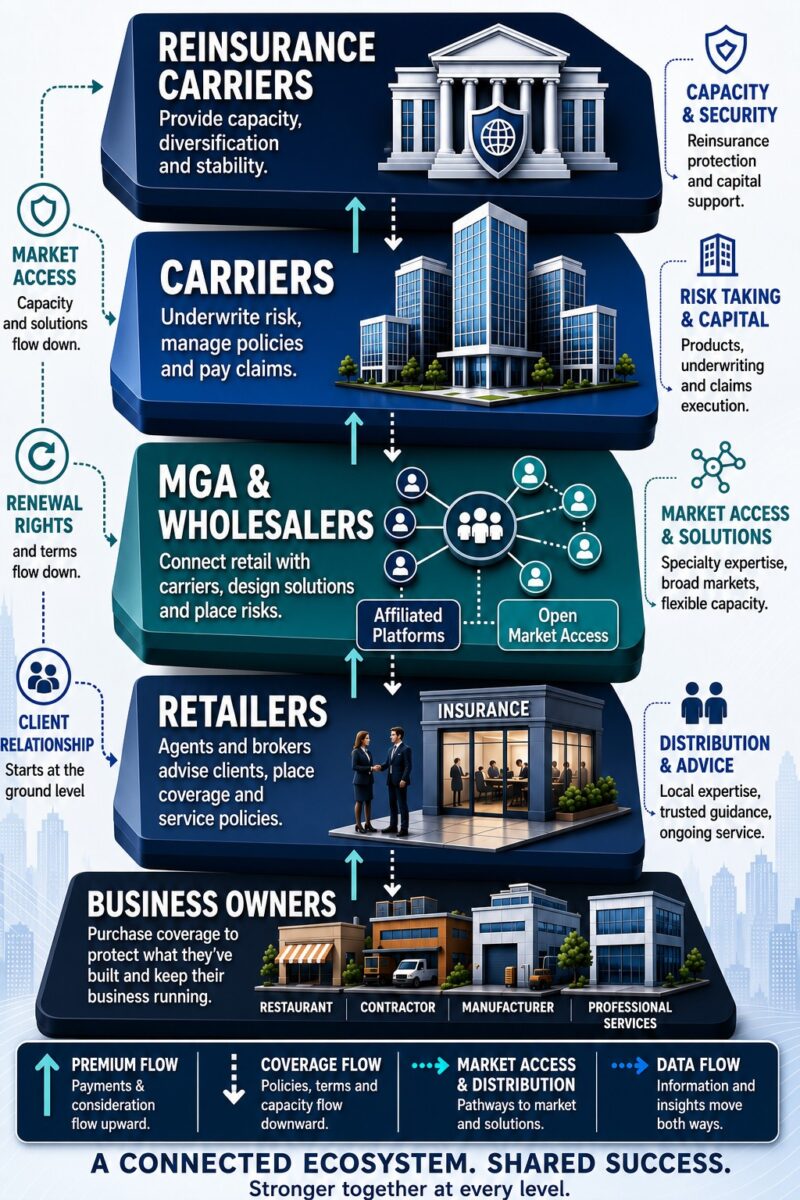
The traditional commercial insurance path was easy to follow:
Business owner → retail agent → wholesaler or MGA → carrier
Today, several of those functions may sit under common ownership.
- HUB International has Specialty Program Group.
- Brown & Brown has assembled Bridge Specialty Group, Arrowhead Programs, and One80 Intermediaries within Arrowhead Intermediaries.
- USI operates Innovation Growth Partners Specialty.
- Gallagher has Risk Placement Services.
- Acrisure has brought several program administrators together under Asero Insurance Services.
- Jencap serves retail agents through wholesale brokerage, binding authority, and program operations, while EPIC operates on the retail side under common ownership.
The same model is spreading beyond the largest national firms.
According to Neilson Marketing Services’ current location data, The Liberty Company Insurance Brokers operates at approximately 50 to 70 retail locations. Its affiliated Aura Risk Management platform serves brokers as an underwriting and wholesale agency across commercial, personal, and specialty lines.
Neilson Marketing Services also tracks approximately 90 ALKEME retail locations. ALKEME operates Brokkrr Insurance Services, a digital MGA platform that automates key parts of broker appointment, quoting, policy administration, and claims submission.
World Insurance Associates is another clear example. Neilson Marketing Services tracks more than 250 World retail locations. World is backed by Goldman Sachs Asset Management alongside Charlesbank Capital Partners and has consolidated its wholesale operations under Novatae Risk Group. Novatae operates as a wholesale brokerage, MGA, and program manager for complex and hard-to-place risks.
These firms differ in size, structure, and strategy. Some focus on wholesale brokerage. Others emphasize delegated authority, binding authority, programs, or digital distribution.
The direction, however, is consistent: Retail organizations want to participate in more stages of the placement.
Why the Strategy Makes Financial Sense
There are sound economic reasons for combining retail and specialty distribution.
Retail brokerage revenue is supported by recurring client relationships and renewals. Wholesale brokers, MGAs, and program administrators become especially valuable when standard markets reduce capacity, tighten underwriting, or withdraw from difficult classes and territories.
Owning both capabilities creates balance across market cycles.
When admitted markets are competitive, retailers may place more business directly with carriers. When conditions harden, wholesale brokers, MGAs, and delegated-underwriting operations become more important. An integrated organization can participate in either environment.
The model can also provide broader access to specialty capacity, faster internal referrals, better visibility into submission trends, more leverage with carriers, and more opportunities to create proprietary programs. It can add commission, fee, and underwriting revenue while making better use of technology and data.
None of that is inherently troubling. A well-run integrated platform can help producers reach experienced underwriters and specialty markets faster.
The concern begins when a preferred internal pathway becomes the only pathway — or when corporate ownership is confused with permanent ownership of the account.
Capital Markets Are Placing a Premium on Distribution Scale
The value being assigned to insurance distribution shows how important these platforms have become.
HUB International confidentially submitted a draft registration statement for a proposed initial public offering on June 26, 2026. The timing, number of shares, and price range had not been determined when HUB announced the filing. The filing followed a 2025 minority investment of approximately $1.6 billion that valued HUB at a $29 billion total enterprise value.
Those figures put a market value on more than commission income. Investors are also valuing recurring revenue, client retention, producer relationships, acquisition capacity, specialty capabilities, and technology.
Additional capital can support acquisitions and specialty-platform expansion. It may also increase pressure to retain more business inside the organization.
That creates an important test: Capital markets may reward a platform for keeping more revenue inside its walls. Clients will judge it by whether it can deliver the right coverage, wherever that coverage is found.
The Independent Market Remains Substantial
Consolidation dominates industry headlines, but the independent channel remains much larger than many observers assume.
According to Neilson Marketing Services’ current insurance distribution data, the company tracks approximately 35,000 retail P&C agency locations nationwide. About 27,000 still show as independent, meaning they are not identified as owned by a national brokerage or private equity-backed retail consolidator.
Roughly 1,700 locations are affiliated with national brokerage organizations, while another 1,700 are identified as private equity-owned retail locations. The balance includes regional organizations, bank-owned agencies, and other ownership structures.
Within the independent count, Neilson tracks approximately 1,943 agencies affiliated with major networks and alliances, including SIAA, ISU Steadfast, Keystone Insurers Group, and Renaissance Alliance.
That distinction matters. Network membership is not the same as ownership. A network-affiliated agency may gain carrier access, technology, profit-sharing opportunities, and scale while retaining local ownership and control of its client relationships.
At the same time, we are beginning to see some networks invest in or acquire member agencies as part of succession and perpetuation strategies. That can give an owner a transition path while helping keep the book of business within the broader network.
Neilson also tracks approximately 2,500 MGA and wholesale locations, including about 1,281 wholesale locations and 1,230 MGA locations. Within those totals are approximately 121 wholesale home offices and 203 MGA home offices.
The counts are approximate because some organizations operate across more than one category, and acquisitions continually change the market. Even so, no national platform operates in a closed system. It competes inside a market containing tens of thousands of retail locations and more than a thousand MGA and wholesale locations.
Underwriting Results Explain Why Market Access Still Matters
Recent industry results show why a commercial account cannot always follow a fixed internal route.
According to AM Best data reported by Insurance Journal, the U.S. P&C industry produced its best underwriting result in a decade in 2025, posting a 93 combined ratio and $61.2 billion in underwriting income. Commercial insurers more than doubled underwriting income to $19.2 billion.
But results varied sharply by line. Commercial auto still recorded an underwriting loss of approximately $1.9 billion. Other liability posted an estimated $11 billion underwriting loss and a 114.7 combined ratio.
That difference matters at the point of distribution.
A carrier or affiliated specialty platform may have strong capacity in one line while tightening limits, raising prices, or restricting appetite in another. The industry can be profitable overall, while a particular restaurant, contractor, trucking company, or staffing firm remains difficult to place.
Distribution behavior is driven by underwriting economics, not simply by ownership.
Commercial Insurance Does Not Fit Neatly Inside One Platform
A commercial account is not always placed as one package through one channel.
A retailer may place property and general liability with one carrier, workers’ compensation through a specialty wholesaler, commercial auto through another market, and excess liability through a separate intermediary.
The reason is usually practical.
A workers’ compensation carrier may object to the class of business, loss history, or experience modification. A commercial auto market may decline the vehicle type or operating radius. A property carrier may restrict wind coverage. An excess market may not provide enough limit. A restaurant may need liquor liability, assault and battery, hired and non-owned auto, property, and workers’ compensation from different sources.
The risk often determines the placement, not the ownership chart.
Through ProgramBusiness.com, we see agencies from every ownership model search outside their customary relationships.
One recent submission involved an incumbent independent agency seeking workers’ compensation coverage for a California metal-cutting company. The package included loss runs, an experience modification worksheet, an ACORD application and a workers’ compensation supplemental. The business was submitted to an independent wholesaler.
Another incumbent retailer sought coverage for a Florida valet and parking-services company. The submission included a garage application, valet supplemental, and driver schedule and was directed to a specialty parking and valet program.
A third agency submitted a veterans’ organization for bar and tavern coverage, including ACORD forms and several years of loss runs.
In another case, a retail office belonging to a national brokerage submitted a restaurant account through the ProgramBusiness Directory to a specialty market outside its corporate platform. The account involved property, general liability, liquor liability, and hired and non-owned auto.
We cannot say why that account went outside the affiliated organization. Pricing, appetite, capacity, policy terms, loss experience, or an existing market relationship could all have played a role.
What the submission does show is this: Common ownership may influence where an account is marketed first. It does not guarantee where the business will ultimately be placed.
The Limits of a Closed Distribution Model
The industry has seen this tension before.
Captive agents and direct writers generally operate within the products, pricing, and underwriting appetite of one parent company. That structure can provide speed, brand consistency, and operational control. It also creates a hard limit.
When the parent company cannot accommodate the risk, the agent may have few alternatives. Some accounts must be declined, reduced, or referred elsewhere, even when the agent has a strong client relationship.
There is a useful parallel in the 1947 film “Miracle on 34th Street.” Kris Kringle, working as Macy’s Santa, sends a shopper to another store for a toy that Macy’s does not have. Management initially sees the practice as disloyal. The customer sees it differently and rewards Macy’s for putting her needs ahead of the immediate sale. Macy’s eventually recognizes that helping shoppers find the right product — even elsewhere — can build loyalty rather than weaken it.
The same principle applies to insurance distribution.
A retailer does not weaken the client relationship by looking outside an affiliated platform when the right solution is unavailable internally. Done properly, that decision can strengthen the relationship because it shows that the client’s needs come before the organization’s preferred distribution path.
That history matters as large retail brokerages build their own wholesale and MGA platforms. The question is not whether those platforms can handle more business internally. They can.
The real test comes when the affiliated platform cannot provide the right coverage, terms, limits, price, or capacity. The retailer then has four choices:
- Look outside the organization.
- Accept a weaker solution.
- Leave part of the account unplaced.
- Risk losing the client.
Integrated distribution should not recreate the limitations of a captive model. Its advantage should be broader access, not fewer options.
A platform proves its value not only by how much business it keeps inside its walls but also by how well it serves the client when the right solution exists outside them.
Trust Is Essential to Affiliated Wholesale Distribution
When an independent agency submits business to a wholesaler or MGA owned by a retail brokerage, trust becomes part of the placement decision.
The submission may contain detailed information about the insured, current coverage, loss history, exposures, and renewal needs. Retail agents expect that information to be used to evaluate and place the account, not to compete with the agency that brought the opportunity forward.
For integrated organizations, that creates an important operating responsibility. Retail and specialty divisions may share common ownership, but outside producers need confidence that appropriate boundaries govern access to client and submission information.
Clear policies around confidentiality, affiliate access, data use, and account solicitation can strengthen that confidence. Written standards, access controls, and employee training help show that the wholesale or MGA operation is committed to protecting its retail trading partners.
ProgramBusiness serves as a market-access channel connecting retail agents with the specialty organizations they choose. The data-governance question discussed here concerns how commonly owned retail and specialty operations manage information inside their own organizations.
Renewal Rights Are Based on Contracts
The industry frequently says an agency “owns the expirations.” That may be true, but the right is usually defined by a producer agreement and often includes conditions.
A Burns & Wilcox producer agreement, in Section 2(b), states that the producer controls expirations and renewals. If the producer fails to account for or pay amounts owed, however, the expirations, renewals, and related future commissions can become the property of Burns & Wilcox.
A Hartford Producer Agreement generally restricts the company from using records obtained through the producer to solicit insureds for other lines without approval. But control of records, expirations, and renewals can shift to the company when amounts remain unpaid after termination. The agreement also recognizes the policyholder’s role: When there is a dispute over which producer represents the insured, the policyholder’s latest written designation controls, subject to company rules.
Ryan Specialty’s National Producer Agreement says the producer’s records and expirations remain the producer’s property during the relationship and after ordinary termination. If undisputed amounts remain unpaid, Ryan may obtain use and control of those expirations to recover the debt. The agreement also permits the use of anonymized or aggregated information for analytics, research, and product development.
These agreements show why ownership is not one simple right.
The retailer may control the expiration. The wholesaler may retain the submission record. The MGA may retain underwriting and transaction data. The carrier may own its pricing models, underwriting notes, and claims records. The insured may appoint a new producer.
The Data Question Is More Complicated Than Ownership
Rather than asking who owns all the data, the better question is: Who may use each category of information, for what purpose, and under what authority?
- The policyholder provides payroll, revenue, property values, driver information, financial details, and loss history.
- The retail agency adds coverage analysis, account history, marketing strategy, carrier discussions, service records, and producer notes.
- The wholesaler or MGA creates quote records, market responses, declinations, tax calculations, placement history, and underwriting communications.
- The carrier develops pricing information, risk scores, underwriting analysis, inspection results, policy records, claims files, and renewal models.
Some of that information comes from the insured. Some is developed by the agent. Some is proprietary work product. Some is protected personal or confidential business information. Some may be used in anonymized or aggregated form.
The practical questions are about custody, consent, confidentiality, permitted use, retention, security, and affiliate access — not a blanket claim that one party owns everything.
The Policyholder Is Often Missing From the Ownership Debate
The industry frequently debates whether the carrier, agent, wholesaler, or platform owns the account. Far less attention is given to the business owner who supplied the information and paid for the policy.
The insured experiences the coverage, pricing, claims service, and consequences of the placement. The insured can also decide that the arrangement no longer works.
Commercial accounts may remain with the same retailer for seven or eight years, but that does not make the relationship permanent. Prices change. Exclusions expand. Claims service deteriorates. Carriers leave states and industries. Capacity contracts. New programs enter the market.
The insured may hire another broker, issue a broker-of-record letter, or request a different placement strategy.
The retailer’s strongest protection is not a theory of perpetual ownership. It is the quality of the relationship, the advice provided, and the ability to keep solving the client’s problems.
What 27 Years of Market Activity Tells Us
For 27 years, ProgramBusiness.com has provided a direct view into how retail agents search for specialty markets when standard or familiar channels cannot solve an account.
Today, the platform serves approximately 65,000 active retail insurance professionals and connects retailers with thousands of programs offered by MGAs, wholesalers, program administrators, and carriers.
The activity is not limited to casual website traffic. Retailers use the platform to make direct calls, send detailed inquiries, and submit Request-a-Quote packages that may include applications, loss runs, supplemental forms, driver schedules, and other underwriting information.
The users come from every major retail ownership model. Independent agencies account for most activity, but offices affiliated with private equity-backed retailers and national brokerage organizations also search outside their primary platforms.
That behavior matters more than any single traffic statistic.
It shows that commercial insurance distribution remains open and account-driven. A retailer may have preferred markets, internal referral systems, or affiliated specialty operations, but those resources will not solve every risk. When coverage, price, capacity, or appetite does not fit, the retailer keeps searching.
ProgramBusiness does not prove that integrated platforms are ineffective. It shows that no platform can satisfy every commercial insurance need from within its own walls.
Choice and Trust Remain Central to Specialty Placement
Integrated retail, wholesale, and MGA organizations will continue to grow, but their success with outside agencies depends on trust and market choice.
Retail agents need confidence that they control where an account is submitted and which specialty market receives the opportunity. They also need clear information about common ownership, the role of each organization and how client information will be handled.
On ProgramBusiness.com, the retailer selects the market or MGA it wants to approach. The platform connects the agency with the chosen specialty provider. The retailer decides where to direct the inquiry or submission based on coverage needs, underwriting appetite, geography and other placement considerations.
For integrated specialty organizations, clear operating standards can strengthen that relationship. Those standards may address confidentiality, affiliate access, renewal rights and protection of the originating retailer’s client relationship.
The goal should not be to limit integrated distribution. It should be to give outside agents enough clarity and confidence to use those platforms voluntarily.
The retailer controls the submission. The market evaluates the risk. The policyholder retains the right to choose.
Distribution May Consolidate, but Control Will Remain Limited
The industry will continue building larger platforms. National brokerages will acquire more retail agencies. Private equity will keep backing consolidators. Wholesale brokers and MGAs will be combined into larger specialty operations. Technology will improve submission routing, data collection, and account analysis.
Capital markets will continue rewarding scale, recurring revenue, and participation in more stages of the transaction.
But these organizations will not own the customer for life.
The market remains too broad. Coverage needs are too specialized. Carrier appetites change too quickly. Independent retailers, agency networks, wholesalers, MGAs, standard carriers, and Lloyd’s markets continue to provide alternatives.
The strongest platforms will not be those that try to trap every account inside a corporate silo.
They will be the ones producers choose to use because the platform delivers the right market, protects the retailer’s relationship, and respects the policyholder’s right to choose.